
PIONEER V-LOCK®
Tank Wall
Engineered up to 2mm thick
Pioneer Water Tanks are engineered for strength, durability, and long-term performance. Their innovative design strategically places steel where it’s needed most to maximise structural integrity without unnecessary material.
When it comes to water tanks, thicker isn’t always better—smart engineering makes the real difference.
How thick are Pioneer
steel water tanks?
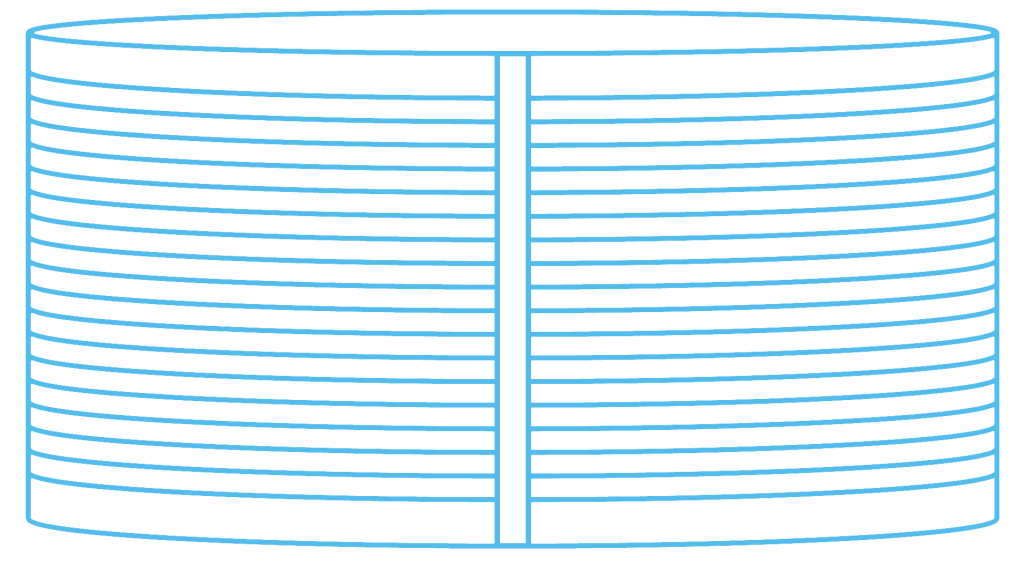
| Tank Size | Bottom Ring | Middle Ring | Top Ring |
|---|---|---|---|
| GT500 | 2mm | 1.6mm | 1mm |
| GT410 | 2mm | 1.6mm | 0.8mm |
| GT370 | 2mm | 1.2mm | 0.8mm |
| GT200 | 1.2mm | N/A | 0.8mm |
| GT130 | 1mm | N/A | 0.8mm |
| Up to GT110 | 0.8mm | N/A | 0.8mm |
Designed for durability
The more complex the profile, the stronger the steel—a principle applied in many industries, including automotive design. Just as car manufacturers shape body panels with curves and contours to enhance strength and rigidity, Pioneer Water Tanks uses advanced profiling in their tank wall design to increase durability and structural performance.
Flat steel alone offers limited strength, but thoughtful engineering turns it into a highly resilient material built to withstand demanding conditions.

Saving your tank liner
A feat of engineering excellence, the PIONEER V-LOCK® wall profile provides superior internal support for the tank liner.
The PIONEER V-LOCK® Design
The PIONEER V-LOCK® wall profile features flatter corrugations compared to traditional tank designs. This flatter surface reduces the amount of flex and stress placed on the tank liner during water cycling, as the liner is not forced into deep ridges or curves.
As a result, the AQUALINER Fresh® liner—like the rest of the tank—benefits from increased longevity, thanks to the thoughtful engineering behind the PIONEER V-LOCK® design.
Liner Damage in Other Tanks
In conventional tank designs, the liner is repeatedly stretched into deep wall corrugations during each water level cycle. Over time, this constant flexing—combined with water pressure—places significant stress on the liner material.
These repeated stresses can eventually lead to mechanical failure, reducing the lifespan of the liner and compromising the integrity of the tank.
Available in a variety of colours
All Pioneer Water Tanks are manufactured using genuine ZINCALUME® or COLORBOND® steel, delivering long-lasting durability and helping the tank maintain its appearance over time—even in harsh Australian conditions.
FAQs
Are your tanks suitable for irrigation purposes?
Pioneer Water Tanks are manufactured and engineered for a wide range of applications, including agricultural and irrigation use. Built to withstand demanding conditions, these tanks are well-suited to handle the rigours of irrigation systems and high-volume water storage.
Do you offer tanks for my home on a farm?
Yes, Pioneer Water Tanks can be supplied with fittings and features specifically designed to accommodate roof water harvesting systems. These tanks are ready to integrate with your existing setup, making it easy to collect and store rainwater efficiently.
What setup do you recommend for an irrigation tank?
When drawing water from a dam or bore, Pioneer Water Tanks recommends, where possible, installing the inlet at the bottom wall of the tank. While it may seem unconventional, bottom inlets can offer improved performance in these setups by allowing better water flow and pressure.
For roof-harvested rainwater, the standard configuration with a roof-level filter basket is recommended to ensure efficient water capture and filtration.
Why is a bottom inlet helpful?
Top inlets can cause minor wave action on the water surface as water enters the tank, and in some cases, may lead to splashing into the roof area of the tank. Where possible, this setup should be avoided to maintain optimal water quality and minimise internal moisture exposure to structural components.
What other steps should I consider with a bottom inlet?
When filling a tank via a bottom inlet, water is introduced directly into the existing volume, allowing levels to rise and fall smoothly without creating splashing or disturbance inside the tank. Despite what you might expect, the existing water volume does not push back into the inlet.
It’s also important to understand how head pressure works. Delivering water to the top of a two-metre tank results in two metres of head pressure. If the water level sits at one metre, there’s one metre of head pressure; if it’s at two metres, you have two metres of head pressure—and so on.
This principle is useful when designing your water delivery system for maximum efficiency and flow control.
Do you have a gutter system for your tank?
In over 30 years of experience, Pioneer Water Tanks has found that only a small number of properties lack sufficient roof catchment area for effective rainwater harvesting.
For those who still require additional water collection, Pioneer offers the innovative Smart Water Savers—a solution designed to harvest rainwater from the roof of the tank itself, increasing overall water capture.
What features come with my water tank?
Pioneer Water Tanks come equipped with a comprehensive range of high-quality features, including:
-
AQUALINER Fresh® antimicrobial tank liner
-
Double fusion-welded liner seams for added durability
-
Adaptive swivel foot roof truss connectors
-
Heavy-duty hinged access hatch
-
External hook-on ladder
-
80mm overflow outlet
-
80mm outlet and valve (with multiple outlets available if required)
-
50mm inlet fitting
These standard inclusions are designed to ensure long-term performance, water quality, and ease of access.
[elementor-template id=”12346″]
Back to top